

Last Updated: November 7, 2026
Quick Summary
Valuing a magic card collection means working through five steps in order: sort, identify, price, adjust, and total. Sort by set, rarity, and condition, identify each card's exact set and printing, then price against a live market source rather than memory. Adjust for condition, foil status, and language, and separate bulk from singles when you total.
- Read the set symbol, collector number, and card language before looking up any price.
- Use sold data for collection estimates and record which source you used and the date.
- Build an MTG collection spreadsheet with columns for finish, language, condition, and adjusted value.
- Grade the worst feature of a card, not the average, because buyers price to the flaw.
- Value bulk as a lot by sampling boxes, not card by card.
Table of Contents
- Start With a Repeatable Valuation Workflow
- How to Tell What Set a Magic Card Is From
- Use a Magic: The Gathering Cards Value App and Price Sources Wisely
- Track Everything in an MTG Collection Spreadsheet
- Adjust for Condition, Finish, and Bulk
- How to Sell a Magic Card Collection Without Guessing
- Frequently Asked Questions
Start With a Repeatable Valuation Workflow
Valuing a Magic card collection means working through five steps in order: sort, identify, price, adjust, and total. Skip a step and your number drifts. In our experience with collectors, the process is often where valuations go wrong.
Here is the workflow that holds up:
- Sort by set, then by rarity, then by condition.
- Identify the exact set, printing, and finish for each card.
- Price each card against a live market source, not memory.
- Adjust for condition, foil status, and language.
- Total the results and separate bulk from singles.
That is the short answer to how to value a magic card collection. The rest of this guide walks through each step with the detail that decides whether your final number is close or wildly off.
The whole valuation comes down to five steps, run in this order.
| Step | What to do |
|---|---|
| Sort | By set, then rarity, then condition |
| Identify | Exact set, printing, and finish for each card |
| Price | Against a live market source, not memory |
| Adjust | For condition, foil status, and language |
| Total | Separate bulk from singles |
How to Tell What Set a Magic Card Is From
Every Magic card carries its set identity in three places: the set symbol, the collector number, and the language of the card. Read all three before you look up a price.
The set symbol identifies the set a card comes from. Each set has its own icon, and reprints reuse the same card name under a different symbol. A card with the same name from two different sets can sit far apart in value.
The collector number appears at the bottom of the card, in the format "number/total." This is the most reliable identifier for modern cards. It tells you the exact position in the set and flags alternate treatments.
Watch out: two cards with identical names, identical art, and identical text can still be different printings. Check the set symbol and collector number together, never one alone. For older cards, the border color and frame style help narrow the era, but the symbol remains the anchor.
Use a Magic: The Gathering Cards Value App and Price Sources Wisely
A Magic: The Gathering cards value app speeds up pricing, but it does not replace judgment. Most apps pull from a market database and return a single number. That number is a starting point, not a verdict.
What to check in any price source:
- Which finish it prices. Non-foil and foil are separate markets.
- Which condition it assumes. Many sources default to near mint.
- When it last updated. Prices move.
- Whether it shows sold data or asking prices. Asking prices run high.
Why Two Sources Give Two Prices
Two sources disagree because they measure different things. One may report the lowest active listing, another the average completed sale, and a third a buylist offer. None is wrong. They answer different questions.
For a collection estimate, use sold data where you can find it. For a quick check on a single card, a market price from a large database is fine. Just write down which source you used and the date, so your total stays honest.
Track Everything in an MTG Collection Spreadsheet
An MTG collection spreadsheet turns a pile of cards into a number you can defend. Build one before you start pricing, not after.
Keep these columns:
- Card name
- Set and collector number
- Finish (non-foil or foil)
- Language
- Condition
- Quantity
- Price source and date
- Adjusted value
Sort by adjusted value, highest first. The top of that list is where your collection's value actually lives. The bottom is bulk, and bulk gets valued by the box, not the card.
Adjust for Condition, Finish, and Bulk
Condition moves value more than most sellers expect. A card in near mint condition sits at the top of its range. The same card with edge wear, surface scratches, or a crease drops well below it. Foil versions trade in their own market and do not simply multiply the non-foil price.
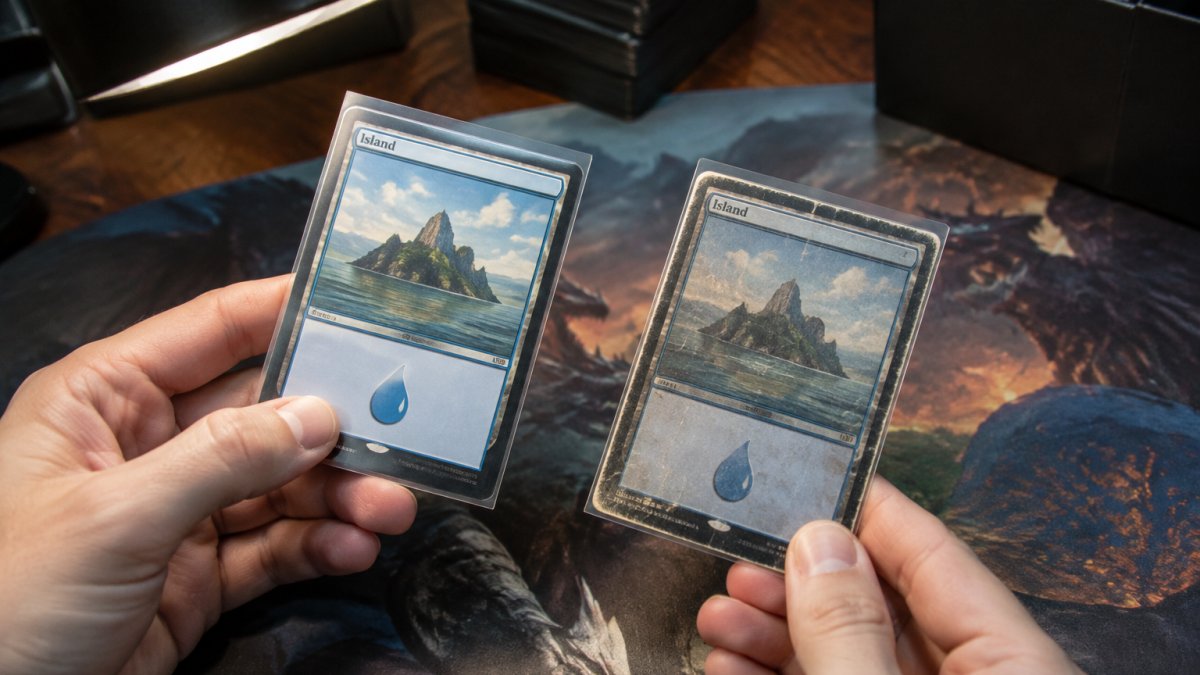
The trick is to grade the same way every time, so your adjustments are consistent across hundreds of cards. Most practitioners use a simple three-pass check: back edges first, then front surface, then corners and centering. Grade the worst feature, not the average, because buyers price to the flaw.
For a practical walkthrough of judging wear, see our guide on how to verify Magic card condition before you buy. The same checks work in reverse when you grade your own cards.
Grading Condition With Practical Examples
Borderline cases are where estimates drift. Use these tie-breakers:
- Whitening you can feel with a fingernail pushes a card from lightly played toward moderately played.
- A single soft corner on an otherwise clean card usually stays lightly played; a bent corner with a crease line does not.
- Surface scratches visible only at a steep angle are minor; scratches visible straight-on under normal light are not.
- Any crease that breaks the surface moves the card to heavily played or damaged, even if it is small.
- Ink marks, water staining, and sun fading count as damage even when the edges look clean.
Pull each card out of the sleeve and tilt it under a lamp. Whitening on the back edge is the fastest tell. Then check the front surface at an angle for scratches.
Finish needs its own line in your notes. A foil card is a separate printing with its own buyer pool, and some foils carry a premium while others sit close to the non-foil price. Never apply a blanket multiplier.
Bulk needs its own treatment. Sort bulk into rares and commons, then sample a handful from each box to confirm nothing valuable slipped through. Value bulk as a lot, not card by card, and be honest that most bulk does not sell at its listed price individually.
How to Sell a Magic Card Collection Without Guessing
Selling starts with the number you just built, but that number is a market value, not what you keep.
The useful figure is net proceeds: what actually reaches you after selling costs. Build a second column in your spreadsheet for it, and subtract these before you compare routes:
- Marketplace and payment fees. Selling platforms and payment processors take a cut of each sale. Check the current fee schedule for whichever platform you use rather than assuming.
- Shipping and materials. Top singles usually ship in a sleeve, top loader, and bubble mailer. That cost comes out of each individual sale, so it hits low-value singles hardest.
- Buylist spreads. A buylist pays a wholesale rate below market, often a meaningful percentage under the retail figure, in exchange for speed and no listing work.
- Your time. Photographing, listing, answering questions, and packing take hours across a large collection. Time is a real cost even when it is not a line item.
Before you sell, decide your goal. If you are unsure, our article on the best way to trade Magic cards without getting burned covers the middle path.
Whichever route you pick, our guide on how to sell your Magic card collection for top value covers the process from start to finish.
Watch out: prices move, so recheck your top cards against a live source on the day you list or accept an offer.
One last check before you commit: confirm the exact card, set, printing, language, finish, quantity, and listed condition on any offer sheet. A missing foil notation or a wrong set can change the deal.
Ready to turn that sorted list into cards you actually want?
Frequently Asked Questions
How much is my Magic: The Gathering collection worth?
There is no single number until you do the work. Separate valuable cards from bulk, identify each card's set and printing, then check current market prices from more than one source. Adjust for condition and finish, and remember that a collection's sale value is usually lower than its summed retail value because buyers account for sorting time and resale risk. A spreadsheet keeps the running total honest as you work through boxes.
What is the 75% rule in MTG collection sales?
Some sellers talk about a rule of thumb for buylist offers, but offers vary widely. Expect an offer below market value, often lower for bulk or slow-moving cards. Treat it as a starting point for negotiation, not a guarantee. Actual offers depend on condition, demand, and how much of the collection is genuinely sellable. Compare a few offers before deciding.
How do card condition and printing affect Magic card value?
Condition and printing can swing a card's value dramatically. A near-mint copy typically commands more than a played or damaged one, and foil or alternate-art versions often carry a premium over the standard printing. Always check the exact set, edition, and finish before pricing. A card that looks identical at a glance may be a reprint from a different set with a very different market price.
How do I sell a Magic card collection after valuing it?
Once you have a realistic total, decide whether to sell as a single lot or break it into valuable singles and bulk. Selling singles usually nets more but takes longer; selling the whole collection is faster and simpler. Get quotes from more than one buyer, confirm what condition they assume, and factor in shipping or drop-off costs. Keep your spreadsheet handy so you can compare offers fairly.
