

Last Updated: November 8, 2026
Quick Summary
Safe shipping for trading cards means the card never touches the mailer directly: sleeve it, seal it in a rigid holder with painter's tape on one edge, sandwich it between two cardboard sheets, then use a padded envelope or box matched to the card's value. Shake the finished package before mailing, and buy tracking for anything worth more than the postage.
- Seal the holder with painter's tape on one edge only, never tape the card or sleeve directly.
- Use two cardboard sheets slightly larger than the holder, taped at the edges, not across the face.
- Ship graded slabs in a box padded on all six sides, never in a padded envelope alone.
- Envelope shipping suits one low-value single at most, and only in a rigid or padded envelope.
- Photograph the packed item before sealing and keep the tracking number and carrier receipt.
Table of Contents
- What You Need Before You Pack a Single Card
- How to Ship Trading Cards on eBay Without Damage
- The Cheapest Way to Ship Cards With Tracking
- Shipping Sports Cards With Envelope: When It Works
- Shipping Graded Trading Cards and Slabs Safely
- Test Your Package Before You Hand It Over
- Frequently Asked Questions
What You Need Before You Pack a Single Card
Safe shipping for trading cards starts with one rule: the card never touches the mailer directly.
- Penny sleeves for every single card
- Rigid holders: top loaders or semi-rigid Card Savers
- Team bags to seal the holder
One more thing worth having on hand: somewhere to keep cards sorted before they go out. A 4-row storage box keeps stacks separated while you work through an order.

If you are new to this, our walkthrough on how to ship trading cards safely covers the full process.
How to Ship Trading Cards on eBay Without Damage
Shipping trading cards on eBay without damage comes down to one sequence: sleeve, holder, seal, rigid support, right mailer. Skip a step and you are gambling with someone else's card.
Sleeve, Holder, Then Seal
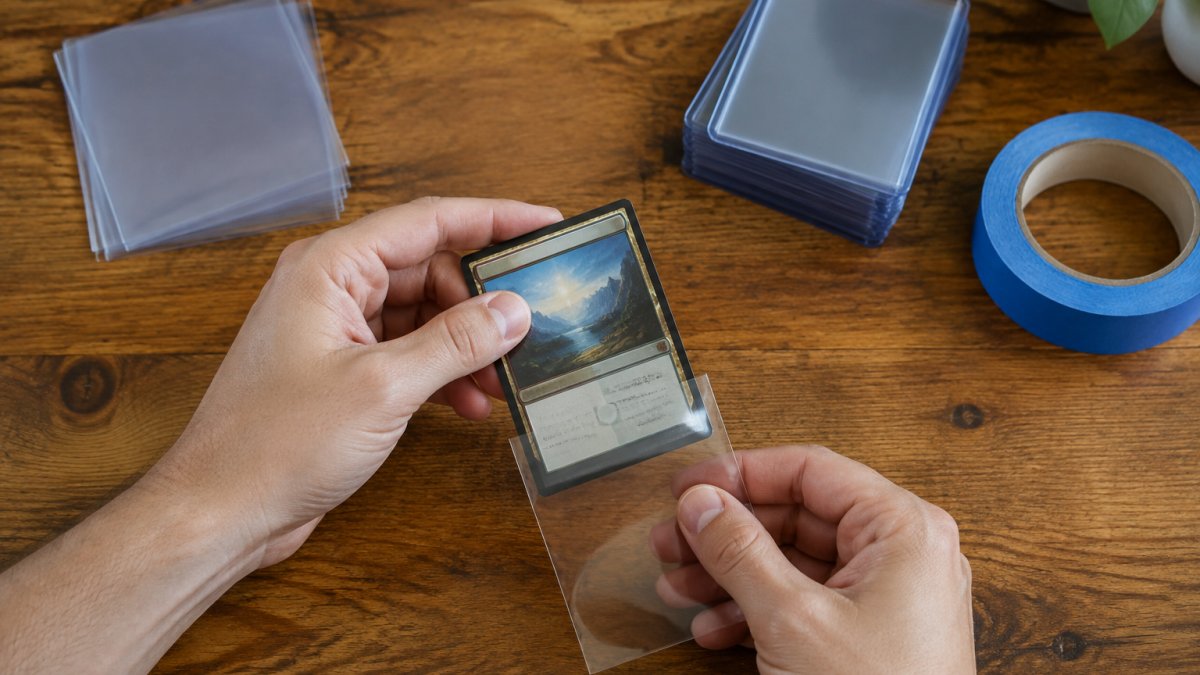
Start with a penny sleeve. Slide the card in so the opening faces down inside the next layer.
Next comes the rigid layer.
Then seal the holder. Use a strip of painter's tape across the opening, folded at one end so the buyer can peel it off.
Watch out: taping the top loader shut completely makes it hard to open, and buyers often damage the card getting it out.
Rigid Support and the Right Mailer
A top loader protects the card, but the holder itself can still be crushed. Add two pieces of cardboard, one on each side, slightly larger than the holder. Tape them together at the edges, not across the face.
For the outer layer, choose based on value and shipment size, not habit:
| Shipment | Inner Protection | Outer Mailer |
|---|---|---|
| One low-value single | Penny sleeve + top loader | Padded envelope |
| One mid-value single | Sleeve + top loader + team bag | Padded envelope + cardboard |
| Several cards | Sleeves + holders, bundled | Small box with padding |
| High-value or graded | Sleeve + holder + team bag | Box with bubble wrap |
A plain envelope with no padding is not protection. It is a hope.
What eBay Actually Requires
eBay's trading card rules change and differ by category and seller type. Before you list, check eBay's own help pages for accepted packaging, maximum thickness for envelope services, and tracking requirements.
A few practical points that hold across most listings:
- List the exact card, set, printing, language, finish, and condition in the item specifics. A buyer who receives a different printing can open a "not as described" case no matter how well you packed it.
- Keep the tracking number and carrier receipt. If a buyer claims non-delivery, tracking is your primary evidence.
- Photograph the card in its holder and the sealed package before it goes out, the record you will want if a damage claim is opened.
If you sell on more than one platform, the packaging sequence stays the same but evidence requirements differ. Our guide on how to ship trading cards safely covers the general process; this section is the platform-specific layer on top.
The Cheapest Way to Ship Cards With Tracking
The cheapest way to ship cards with tracking depends on your carrier and service level, not how much tape you use. Tracking is a service you buy, so savings come from the right service tier and keeping the package light and flat.
Here is where sellers lose money: they over-pack a single card into a box, then pay box rates for a shipment that could have gone as a rigid envelope. Weight and thickness drive postage more than anything else.
Match the Service to the Shipment
Most carriers offer a ladder of services; what matters for cards is thickness limits, weight limits, whether tracking is included, and envelope-style eligibility. Names and limits vary by country and change, so confirm on the carrier's official page before relying on a rate.
A common pattern among sellers:
- Low-value singles: a rigid or padded envelope on the cheapest service that includes tracking. If it does not include tracking, treat it as untracked and price the risk accordingly.
- Mid-value singles and small lots: a tracked parcel service with a rigid mailer, still light and flat, with a tracking number attached.
- High-value singles and slabs: a tracked service with signature on delivery where available, plus declared value or insurance.
A few habits that keep costs down without cutting protection:
- Use a rigid mailer instead of a box for single cards
- Keep cardboard support to two sheets, not four
- Print labels at home rather than at the counter
For a deeper look at postage options, our guide on comparing Magic card shipping costs breaks down how service levels affect what you pay.
Insurance, Declared Value, and Proof of Shipment
Packaging guides usually stop at the mailer, but the financial side is where sellers get hurt. Treat these as part of shipping, not an afterthought.
- Declared value. Many carriers let you declare a value above the default coverage limit for an extra charge. It should reflect what the card is worth to replace, not the postage you paid.
- Insurance limits. Default coverage on cheaper services is often low. If your card is worth more, buy additional coverage or use a service with a higher default.
- Tracking as evidence. A tracking number proves the package moved, not what was inside. That is why the pre-shipment photo and item description matter.
Watch out: skipping tracking to save a little on a single card can cost you the whole sale. If a buyer says the card never arrived, an untracked shipment gives you no proof and no claim.
International Shipments
Cross-border sales add customs forms, duties, and longer transit, and your tracking may stop updating once the package leaves your country. Before shipping internationally, check the carrier's guidance for customs descriptions ("trading card" is usually clearer than a vague category), restricted services, and what tracking covers door to door.
Shipping Sports Cards With Envelope: When It Works
Shipping sports cards in an envelope works for low-value singles and only when the envelope is rigid or padded.
The envelope method has real limits:
- One card per envelope, two at most
- Always a rigid mailer or a padded envelope with cardboard
- Never a plain paper envelope with a card inside
Envelope shipping is a value decision. For a cheap single headed to a casual buyer, a padded envelope with a top loader and cardboard is fine.
Also check the rules of the marketplace you sell on. Some platforms set their own requirements for protected shipping, and those rules change.
Shipping Graded Trading Cards and Slabs Safely
Graded cards and slabs need different handling because the slab is rigid but brittle at the corners.
The process:
- Put the slab in a graded card sleeve if you have one. It protects the surface from scuffs.
- Wrap the slab in bubble wrap, two layers on the corners.
- Place it in a box with padding on all six sides. The slab should not move when you shake the box.
- Seal the box with packing tape along all seams.
- Label it clearly and add tracking.
Never ship a slab in a padded envelope alone. The corners take the impact, and a chipped slab is a damaged card in the buyer's eyes.
If you are storing slabs before they sell, keep them upright and away from heat. Slabs are best kept flat in a dedicated case.
Test Your Package Before You Hand It Over
Test your package before you hand it over. Shake it gently next to your ear. If you hear movement, add padding.
Here is the pre-shipment check we use:
- Card is in a sleeve, opening facing down
- Holder is sealed with painter's tape, one edge only
- Cardboard support is slightly larger than the holder
That last item matters more than people think.
For international shipments, check customs forms and prohibited items before you pack.
Packing a card well takes a few minutes and a small stack of supplies. Getting it wrong costs a sale, a card, and a buyer's trust.
Frequently Asked Questions
What is the safest way to ship trading cards?
Put the card in a penny sleeve first, then into a rigid top loader or semi-rigid card saver, and seal the opening with painter's tape. Sandwich that between two pieces of cardboard and place it in a rigid mailer or padded envelope. Safe shipping for trading cards comes down to three things: a sleeve against scratches, a rigid holder against bending, and a mailer that keeps the card from sliding around.
Should trading cards be shipped in a top loader or a card saver?
Both work, but they suit different jobs. A top loader is rigid and easy to tape shut, which makes it a good choice for a single card you want to keep flat. A semi-rigid card saver holds the card snugly and is often preferred when a card is headed to a grading service, since graders can remove it without stressing the card. Whichever you use, put the card in a penny sleeve first.
Is it safe to ship cards in an envelope?
A plain paper envelope is not safe on its own. Cards shipped that way bend, crease and pick up corner damage in sorting machines. If you use an envelope, choose a padded one and still put the card in a sleeve and rigid holder with cardboard support. For anything valuable, use a rigid mailer and add tracking so you have proof of shipment if something goes wrong.
How do you ship graded trading cards safely?
A graded card is already inside a hard slab, so the job is protecting the slab itself. Wrap the slab in bubble wrap or place it in a graded card sleeve, then put it in a box with padding on all sides so it cannot shift. Avoid tape directly on the slab, and do not stack heavy items against it. Shipping graded trading cards with tracking and, for higher-value pieces, insurance gives you a record if the parcel is lost or damaged.
